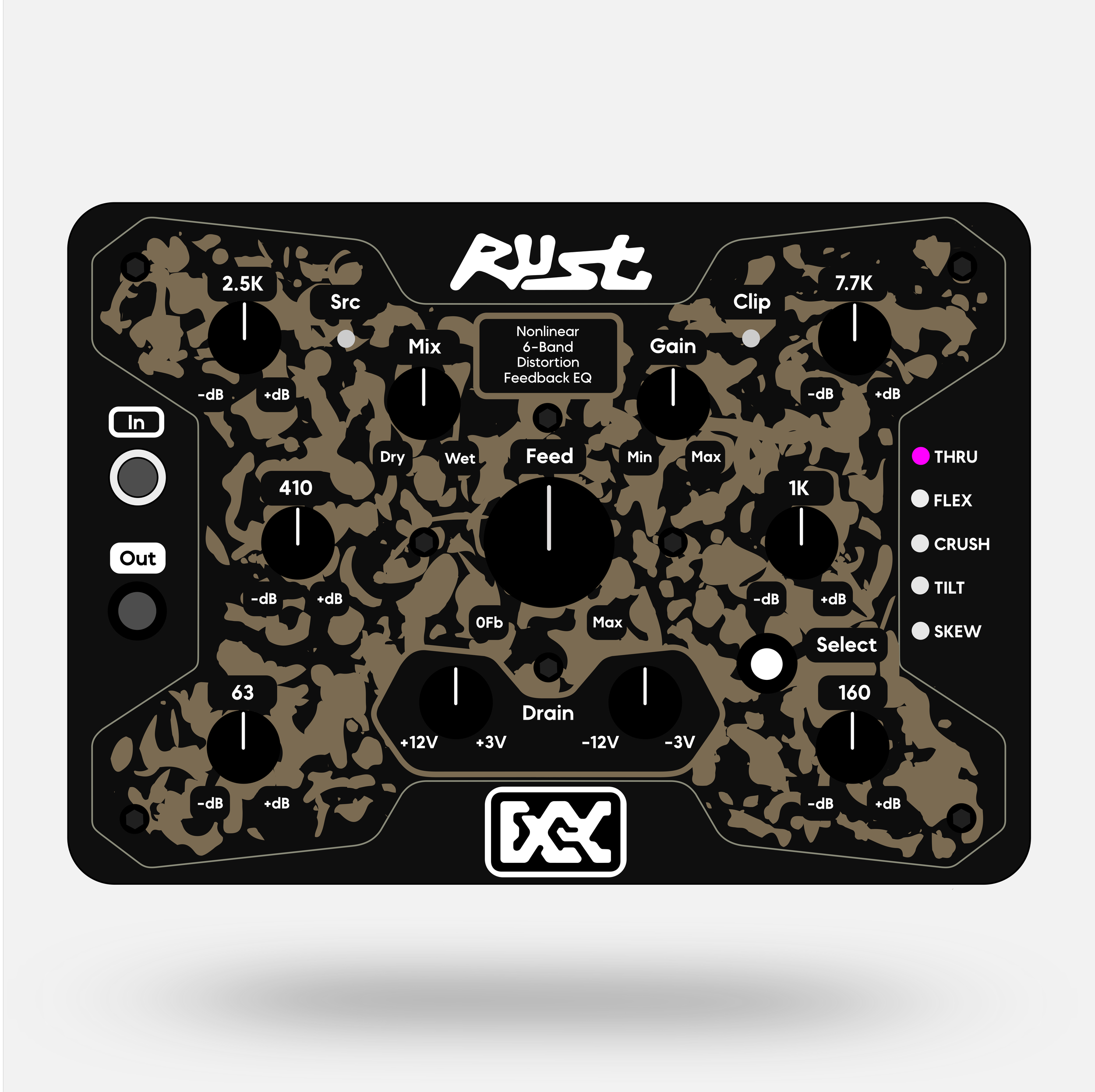
The most distinctive characteristic of Rust is its voltage starvation system, controlled by the Drain section. Two knobs adjust the positive and negative supply rails powering the op-amps responsible for the EQ filters. Under normal operation, the circuits run at approximately ±12 volts, providing high headroom and stable, linear filtering behavior.
Reducing these supply rails down to ±3 volts intentionally pushes the op-amps outside their ideal operating conditions. As headroom collapses, the devices can no longer reproduce rapid signal changes cleanly. Slew rate decreases, internal bias points shift, and the filters begin to saturate internally. Instead of processing a clean signal, the feedback network begins circulating partially clipped or slew-limited waveforms.
It is important to note that the effects of Drain become most apparent when the EQ network is actively driven. When all bands are centered and no feedback is applied, the signal passes through the filters with minimal emphasis, meaning the reduced supply voltage may produce only subtle changes. More pronounced behavior emerges when the filters are pushed by boosting frequency bands or increasing the feedback amount. In these conditions the signal is forced into the limited headroom of the starved op-amps, causing the filters to saturate, compress, and destabilize more aggressively.
Under heavy starvation the gyrator circuits themselves begin to lose their ideal filtering behavior. Because the op-amps no longer operate in their normal linear range, the simulated inductive response collapses and the filters stop behaving as precise resonant networks. Instead, the EQ structure becomes part of a nonlinear feedback system where amplification, saturation, and feedback interaction dominate the sound.
Because the filters operate inside the feedback path, these nonlinearities compound with each pass through the circuit. The result is a distinctive sonic character that can range from subtle compression and harmonic coloration to crushed, grainy textures reminiscent of low-resolution sound engines.
Following the equalisation stage, Rust includes a selectable clipping distortion section that further expands the processor’s sonic range. The clipping stage can be set to 5 different modes using the mode selector.
THRU bypasses the clipping stage, allowing the EQ and feedback network to operate without additional distortion.
FLEX and CRUSH provide soft and hard clipping.
The more interesting behavior appears in TILT and SKEW modes. In these modes the clipping is asymmetrical, meaning one side of the waveform reaches the clipping threshold earlier than the other. When the Gain is increased, the available headroom becomes increasingly unbalanced, narrowing the usable signal window. This causes large portions of the waveform to flatten while only short transients pass through, often breaking rhythmic material such as drum into fragmented bursts.